RIULSRepository of Iași University of Life Sciences, ROMANIA
Exploring Aubrac Cattle as a Benchmark for Sustainable and Nutritious Beef Production
- RIULS Home
- →
- Publicații științifice ale Universității – AgriScriptum / Scientific Publications of the University - AgriScriptum
- →
- 1. Articole publicate in reviste cotate ISI / Articles published in ISI journals
- →
- Facultatea de Ingineria Resurselor Animale si Alimentare/ Faculty of Food and Animal Sciences
- →
- 2025
- →
- View Item
JavaScript is disabled for your browser. Some features of this site may not work without it.
| dc.contributor.author | Mădescu, Bianca-Maria | |
| dc.contributor.author | Matei, Mădălina | |
| dc.contributor.author | Davidescu, Mădălina-Alexandra | |
| dc.contributor.author | Bolohan Acornicesei, Ioana | |
| dc.contributor.author | Lazăr, Roxana | |
| dc.contributor.author | Ciobanu, Marius-Mihai | |
| dc.contributor.author | Simeanu, Daniel | |
| dc.contributor.author | Boișteanu, Paul-Corneliu | |
| dc.date.accessioned | 2025-11-12T10:13:17Z | |
| dc.date.available | 2025-11-12T10:13:17Z | |
| dc.date.issued | 2025-10-13 | |
| dc.identifier.citation | Mădescu, Bianca Maria, Mădălina Matei, Mădălina Alexandra Davidescu, Ioana Bolohan (Acornicesei), Roxana Lazăr, Marius Mihai Ciobanu, Daniel Simeanu, and Paul Corneliu Boișteanu. 2025. "Exploring Aubrac Cattle as a Benchmark for Sustainable and Nutritious Beef Production" Animals 15, no. 20: 2966. https://doi.org/10.3390/ani15202966 | en_US |
| dc.identifier.uri | https://www.mdpi.com/2076-2615/15/20/2966 | |
| dc.identifier.uri | https://repository.iuls.ro/xmlui/handle/20.500.12811/5899 | |
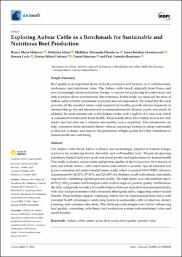
| dc.description.abstract | The Aubrac cattle breed, native to France and increasingly adopted in Eastern Europe, is known for producing tender, flavorful, and well-marbled beef. Despite its growing popularity, limited data exist on its nutritional profile and implications for human health. This study evaluates carcass traits and protein quality in the Longissimus dorsi muscle of male and female Aubrac cattle raised under semi-intensive systems. Special attention was given to essential and semi-essential amino acids, which exceeded FAO/WHO reference requirements by 60.25%, 97.43%, and 221.49% for children, youth individuals, and adults, respectively, confirming superior protein quality. The high amino acid concentration (up to 30.59 g/100 g protein) and biological value confirm superior protein quality. Furthermore, the fatty acid profile reveals a favorable balance between saturated and unsaturated fats, with oleic acid predominance and a moderate atherogenic index, suggesting cardiovascular benefits. These findings support classifying Aubrac beef as a functional protein source with potential health advantages, reinforcing its role in sustainable cattle production, dietary planning, and consumer education. This study provides insights into factors influencing beef quality, connecting cattle breed and production system with nutritional value and health benefits. | en_US |
| dc.language.iso | en | en_US |
| dc.publisher | MDPI | en_US |
| dc.rights | CC BY 4.0 | |
| dc.rights.uri | https://creativecommons.org/licenses/by/4.0/ | |
| dc.subject | Aubrac cattle | en_US |
| dc.subject | amino acids | en_US |
| dc.subject | fatty acids | en_US |
| dc.subject | meat quality | en_US |
| dc.subject | protein value | en_US |
| dc.title | Exploring Aubrac Cattle as a Benchmark for Sustainable and Nutritious Beef Production | en_US |
| dc.type | Article | en_US |
| dc.author.affiliation | Bianca Maria Mădescu , Mădălina Matei , Mădălina Alexandra Davidescu , Ioana Bolohan (Acornicesei) , Roxana Lazăr , Marius Mihai Ciobanu, Daniel Simeanu, Paul Corneliu Boișteanu, “Ion Ionescu de la Brad” Iasi University of Life Sciences, 3 Mihail Sadoveanu Alley, 700489 Iasi, Romania | |
| dc.publicationName | Animals | |
| dc.volume | 15 | |
| dc.issue | 20 | |
| dc.publicationDate | 2025 | |
| dc.identifier.eissn | 2076-2615 | |
| dc.identifier.doi | https://doi.org/10.3390/ani15202966 |
Files in this item
This item appears in the following Collection(s)
-
2025 [8]
 Except where otherwise noted, this item's license is described as CC BY 4.0