RIULSRepository of Iași University of Life Sciences, ROMANIA
The dematerialization of economy - the analysis of the correlation between immaterial capital and sustainable development
- RIULS Home
- →
- Publicații științifice ale Universității – AgriScriptum / Scientific Publications of the University - AgriScriptum
- →
- 2. Articole Lucrări Științifice Universitatea de Ştiinţele Vieţii "Ion Ionescu de la Brad" din Iaşi / Articles of "Scientific Papers" Iași University of Life Sciences (IULS)
- →
- Seria Agricultură / Series Agriculture
- →
- 2009
- →
- View Item
JavaScript is disabled for your browser. Some features of this site may not work without it.
| dc.contributor.author | Mironiuc, Marilena | |
| dc.date.accessioned | 2024-12-02T11:31:35Z | |
| dc.date.available | 2024-12-02T11:31:35Z | |
| dc.date.issued | 2009 | |
| dc.identifier.citation | Mironiuc, Marilena. 2009. "The dematerialization of economy - the analysis of the correlation between immaterial capital and sustainable development". Lucrări Ştiinţifice USAMV - Iaşi Seria Agronomie 52(2): 514-519. | |
| dc.identifier.uri | https://repository.iuls.ro/xmlui/handle/20.500.12811/4910 | |
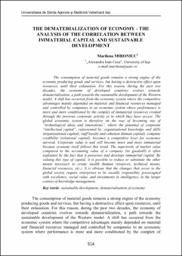
| dc.description.abstract | The consumption of material goods remains a strong engine of the economy producing goods and services, but having a destructive effect upon resources, until their exhaustion. For this reason, during the past two decades, the economy of developed countries evolves towards dematerialization, a path towards the sustainable development of the Western model. A shift has occurred from the economic system where the competitive advantages mainly depended on material and financial resources managed and controlled by companies to an economic system where performance is more and more conditioned by the complex of immaterial resources created through the previous corporate activity or to which they have access. The global economic system is therefore on the way of becoming one of “technological ideas and innovations”, where the potential of corporate “intellectual capital”, represented by: organizational knowledge and skills (organizational capital), staff loyalty and cohesion (human capital), company credibility (relational capital), becomes a competitive lever for economic survival. Corporate value is and will become more and more immaterial because economy itself follows this trend. The superiority of market value compared to the accounting value of a company (its goodwill) is often explained by the fact that it possesses and develops immaterial capital. By valuing this type of capital, it is possible to reduce or substitute the other means necessary to create wealth (human resources, technical means, financial resources, etc.). It is obvious that the changes that occur in the global society require enterprises to be socially responsible, preoccupied with excellence, social value, and investments in intelligence, in the larger context of knowledge management. | en_US |
| dc.language.iso | en | en_US |
| dc.publisher | “Ion Ionescu de la Brad” University of Agricultural Sciences and Veterinary Medicine, Iaşi | en_US |
| dc.subject | sustainable development | en_US |
| dc.subject | dematerialization of economy | en_US |
| dc.title | The dematerialization of economy - the analysis of the correlation between immaterial capital and sustainable development | en_US |
| dc.type | Article | en_US |
| dc.author.affiliation | Marilena Mironiuc, „Alexandru Ioan Cuza”, University of Iaşi | |
| dc.publicationName | Lucrări Ştiinţifice USAMV - Iaşi Seria Agronomie | |
| dc.volume | 52 | |
| dc.issue | 2 | |
| dc.publicationDate | 2009 | |
| dc.startingPage | 514 | |
| dc.endingPage | 519 | |
| dc.identifier.eissn | 2069-6727 |
Files in this item
This item appears in the following Collection(s)
-
2009 [243]