- RIULS Home
- →
- Publicații științifice ale Universității – AgriScriptum / Scientific Publications of the University - AgriScriptum
- →
- 2. Articole Lucrări Științifice Universitatea de Ştiinţele Vieţii "Ion Ionescu de la Brad" din Iaşi / Articles of "Scientific Papers" Iași University of Life Sciences (IULS)
- →
- Seria Medicină Veterinară / Series Veterinary Medicine
- →
- 2025
- →
- View Item
JavaScript is disabled for your browser. Some features of this site may not work without it.
| dc.contributor.author | Hrițcu, Luminița-Diana | |
| dc.contributor.author | Pavel, Geta | |
| dc.contributor.author | Nechifor, Florin | |
| dc.contributor.author | Boghian, Vasile | |
| dc.contributor.author | Anton, Alina | |
| dc.contributor.author | Hrițcu, Teodor-Daniel | |
| dc.contributor.author | Cherșunaru, Alexandra-Andreea | |
| dc.contributor.author | Munteanu, Alexandru | |
| dc.contributor.author | Spătaru, Mihaela-Claudia | |
| dc.date.accessioned | 2025-12-08T08:31:01Z | |
| dc.date.available | 2025-12-08T08:31:01Z | |
| dc.date.issued | 2025 | |
| dc.identifier.citation | Luminița-Diana Hrițcu, Geta Pavel, Florin Nechifor, Vasile Boghian, Alina Anton, Teodor-Daniel Hrițcu, Cherșunaru, Alexandra-Andreea, Alexandru Munteanu, Mihaela-Claudia Spataru. 2025. “The effects of probiotic-based diets on diabetes mellitus in companion animals”. Lucrări Științifice IULS Seria Medicină Veterinară 68 (3): 94-103. DOI: https://doi.org/10.61900/SPJVS.2025.03.16 | en_US |
| dc.identifier.issn | 1454-7406 | |
| dc.identifier.uri | https://repository.iuls.ro/xmlui/handle/20.500.12811/6000 | |
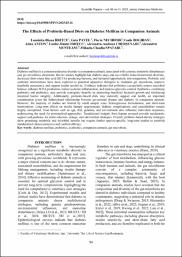
| dc.description.abstract | Diabetes mellitus is a common endocrine disorder in companion animals, associated with systemic metabolic disturbances and gut microbiota alterations. Recent studies highlight that diabetic dogs and cats exhibit reduced microbial diversity, decreased short-chain fatty acid (SCFA)–producing bacteria, and increased opportunistic microorganisms. Probiotic and synbiotic interventions have been explored as potential adjunctive therapies to modulate gut microbiota, improve metabolic parameters, and support insulin sensitivity. Evidence indicates that probiotics can partially restore microbial balance, enhance SCFA production, reduce systemic inflammation, and improve glycemic control. Synbiotics, combining prebiotics and probiotics, may provide synergistic benefits by promoting beneficial bacterial growth and reinforcing intestinal barrier integrity. Additionally, probiotic-based diets may indirectly support oral health, an important consideration given the bidirectional relationship between periodontal disease and diabetes in companion animals. However, the majority of studies are limited by small sample sizes, heterogeneous formulations, and short-term interventions. Long-term effects on insulin therapy requirements, diabetic complications, and comorbidities remain largely unexplored. Host factors such as age, diet, genetics, and environment also influence individual responses, underscoring the need for personalized approaches. Translational insights from human research provide mechanistic support and guidance for strain selection, dosage, and intervention strategies. Overall, probiotic-based dietary strategies show promising metabolic and microbial benefits but require further species-specific, long-term studies to establish standardized clinical protocols and confirm efficacy. | en_US |
| dc.language.iso | en | en_US |
| dc.publisher | “Ion Ionescu de la Brad” Publishing House, Iași | en_US |
| dc.rights | Attribution-NonCommercial-ShareAlike 4.0 International (CC BY-NC-SA 4.0) | |
| dc.rights.uri | http://creativecommons.org/licenses/by-nc-sa/4.0/ | |
| dc.subject | diabetes mellitus | en_US |
| dc.subject | probiotics | en_US |
| dc.subject | synbiotics | en_US |
| dc.subject | companion animals | en_US |
| dc.subject | gut microbiota | en_US |
| dc.title | The effects of probiotic-based diets on diabetes mellitus in companion animals | en_US |
| dc.type | Article | en_US |
| dc.author.affiliation | Luminița-Diana Hrițcu, Geta Pavel, Florin Nechifor, Vasile Boghian, Alina Anton, Teodor-Daniel Hrițcu, Alexandra-Andreea Cherșunaru, Alexandru Munteanu, Mihaela-Claudia Spataru, Faculty of Veterinary Medicine, Iași, University The Life of Science Iași Roumania | |
| dc.publicationName | Lucrări Științifice IULS Seria Medicină Veterinară | |
| dc.volume | 68 | |
| dc.issue | 3 | |
| dc.publicationDate | 2025 | |
| dc.startingPage | 94 | |
| dc.endingPage | 103 | |
| dc.identifier.eissn | 2393-4603 | |
| dc.identifier.doi | 10.61900/SPJVS.2025.03.16 |
Files in this item
This item appears in the following Collection(s)
-
2025 [49]
 Except where otherwise noted, this item's license is described as Attribution-NonCommercial-ShareAlike 4.0 International (CC BY-NC-SA 4.0)