Abstract:
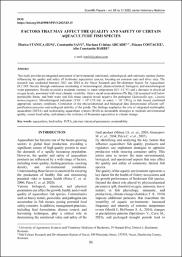
This study provides an integrated assessment of environmental, nutritional, technological, and veterinary-sanitary factors
influencing the quality and safety of freshwater aquaculture species, focusing on common carp and silver carp. The
research was conducted between 2023 and 2024 at the Nucet Research and Development Station for Aquaculture
(S.C.D.P.-Nucet), through continuous monitoring of meteorological, physicochemical, biological, and microbiological
water parameters. Results revealed a moderate increase in water temperature (0.5–1.0 °C) and a decrease in dissolved
oxygen levels, associated with local climatic variability. Heavy metal concentrations (Pb, Hg, Cd) remained well below
permissible limits, and both water and fish tissue samples tested negative for pathogens (Salmonella spp., Listeria
monocytogenes). Microbiological indicators (TVC < 10⁴ CFU/mL in water; < 10² CFU/g in fish tissue) confirmed
appropriate sanitary conditions. Correlation of the physicochemical and biological data demonstrated efficient selfpurification
processes and ecological stability of the ponds. The findings emphasize the role of integrated multitrophic
aquaculture (IMTA) and recirculating aquaculture systems (RAS) as sustainable strategies to maintain environmental
quality, ensure food safety, and enhance the resilience of Romanian aquaculture to climate change.