- RIULS Home
- →
- Publicații științifice ale Universității – AgriScriptum / Scientific Publications of the University - AgriScriptum
- →
- 2. Articole Lucrări Științifice Universitatea de Ştiinţele Vieţii "Ion Ionescu de la Brad" din Iaşi / Articles of "Scientific Papers" Iași University of Life Sciences (IULS)
- →
- Seria Agricultură / Series Agriculture
- →
- 2007
- →
- View Item
JavaScript is disabled for your browser. Some features of this site may not work without it.
| dc.contributor.author | Giurca Vasilescu, Laura | |
| dc.date.accessioned | 2025-10-13T10:35:41Z | |
| dc.date.available | 2025-10-13T10:35:41Z | |
| dc.date.issued | 2007 | |
| dc.identifier.citation | Giurca Vasilescu, Laura. 2007. "The effects of rural SMEs investment on economic development". Lucrări Ştiinţifice USAMV - Iaşi Seria Agronomie 50(3): 516-521. | |
| dc.identifier.uri | https://repository.iuls.ro/xmlui/handle/20.500.12811/5719 | |
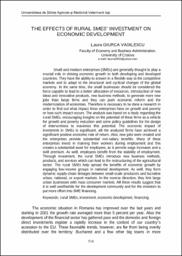
| dc.description.abstract | Small and medium enterprises (SMEs) are generally thought to play a crucial role in driving economic growth in both developing and developed countries. They have the ability to answer in a flexible way to the competitive markets and to adapt to the structural and cyclical changes of the global economy. In the same time, the small businesses should be considered the force capable to lead to a better allocation of resources, introduction of new ideas and innovative products, new business methods, to generate more new jobs than large firms and they can push economic reform and the modernization of economies. Therefore is necessary to be done a research in order to find out what impact these enterprises have on growth and poverty or how such impact occurs. The analysis was based on a study regarding the rural SMEs, encouraging insights on the potential of these firms as a vehicle for growth and poverty reduction and some policy guidelines for the design of interventions to maximize this potential. The economic impact of investment in SMEs is significant, all the analyzed firms have achieved a significant positive economic rate of return. Also, new jobs were created and the enterprises provide substantial non-salary benefits. Many of these enterprises invest in training their workers during employment and this creates a substantial asset for employees, as it permits wage increases and a skill premium. As well, employees benefit from the stability of employment. Through investment, the rural SMEs introduce new business methods, products, and services which can lead to the restructuring of the agricultural sector. The rural SMEs help spread the benefits of economic growth by engaging low-income groups in national development. As well, they form dynamic supply-chain linkages between small-scale producers and lucrative urban, national, or export markets. In the reverse direction, they link large urban businesses with mass consumer markets. All these results suggest that it is well worthwhile for the development community and for the investors to put more effort into SME financing. | en_US |
| dc.language.iso | en | en_US |
| dc.publisher | “Ion Ionescu de la Brad” University of Agricultural Sciences and Veterinary Medicine, Iaşi | en_US |
| dc.subject | rural SMEs | en_US |
| dc.subject | investment | en_US |
| dc.subject | economic development | en_US |
| dc.subject | financing | en_US |
| dc.title | The effects of rural SMEs investment on economic development | en_US |
| dc.type | Article | en_US |
| dc.author.affiliation | Laura Giurca Vasilescu, Faculty of Economy and Business Administration, University of Craiova | |
| dc.publicationName | Lucrări Ştiinţifice USAMV - Iaşi Seria Agronomie | |
| dc.volume | 50 | |
| dc.issue | 3 | |
| dc.publicationDate | 2007 | |
| dc.startingPage | 516 | |
| dc.endingPage | 521 | |
| dc.identifier.eissn | 2069-6727 |
Files in this item
This item appears in the following Collection(s)
-
2007 [245]